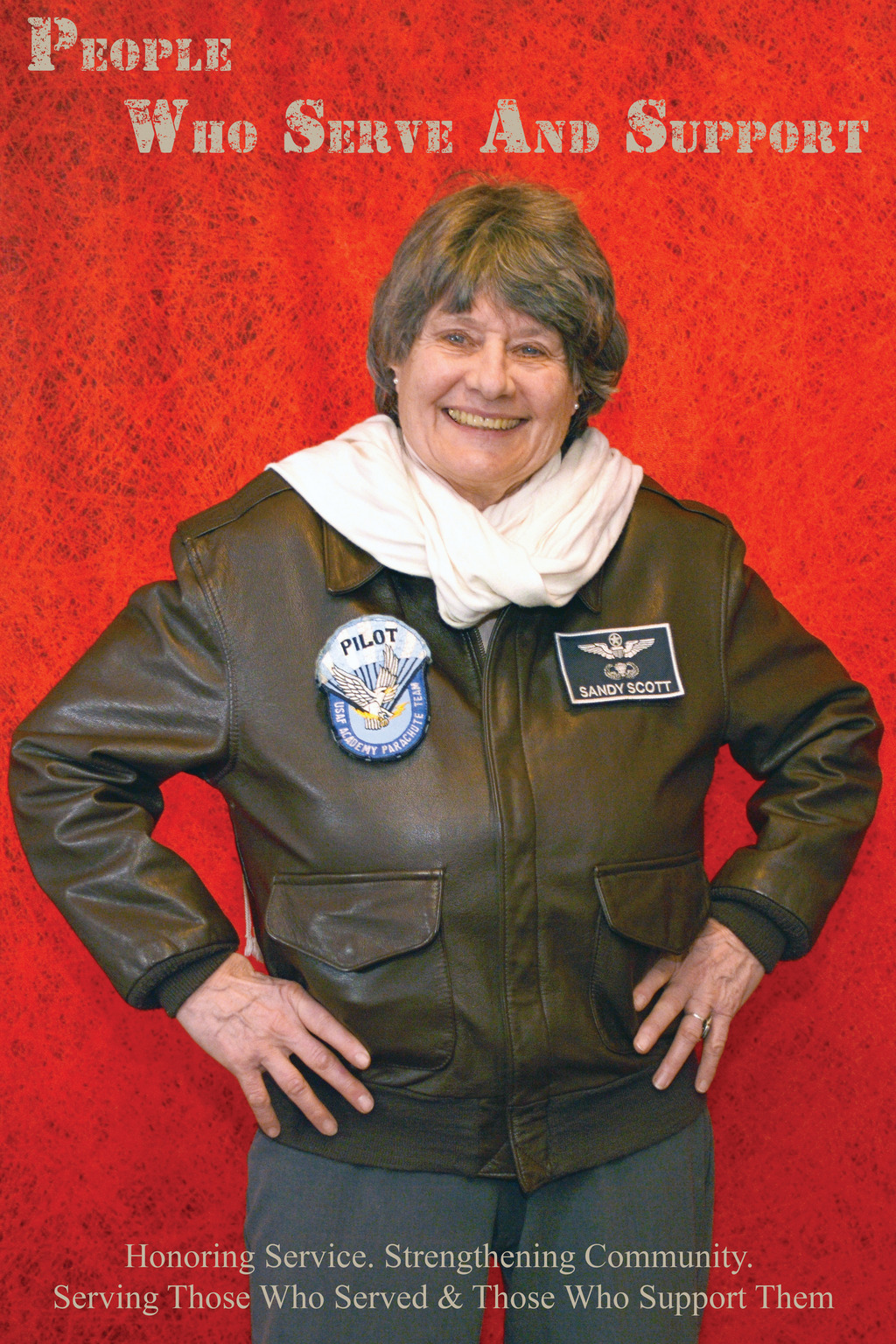
U.S. Air Force Veteran | Military Family Member | Former Pacific Student Lieutenant Colonel, U.S. Air Force (Ret.) | Pilot
#WomenWhoServeAndSupport | #FamiliesWhoServeAndSupport | #CommunityWhoServeAndSupport
Sandy served on active duty in the United States Air Force from 1974 to 1986 and continued her career in the Air National Guard and Reserve, eventually reaching the rank of Lieutenant Colonel. During that time, she became one of the first ten women pilots in the United States Air Force, entering military aviation during a period when women were only beginning to gain access to roles previously closed to them.
Her life has been deeply intertwined with military service across generations. Her father served in the Army National Guard for thirty years, including deployment to the Pacific during World War II. Growing up in that environment, she witnessed duty, honor, and quiet commitment firsthand. Later, she would marry a fellow servicemember, and today her daughter and son-in-law also serve in the Air Force, continuing a family legacy of military service.
Sandy did not join the military because it felt radical or rebellious. It was simply a natural extension of what she had always known. Raised on a farm, she learned early that work needed to be done and that discipline mattered. Her parents instilled in her the belief that she did not need to be limited by others’ expectations. That belief was reinforced when, at sixteen, she discovered that male coworkers at a cannery were paid more for the same work she was doing. It did not make sense to her then, and it strengthened her conviction that ability—not assumptions—should determine opportunity.
When ROTC programs began opening to women, Sandy signed up. When the opportunity to apply for Undergraduate Pilot Training appeared, she did not hesitate. She was not trying to be the first woman in anything—she simply wanted the opportunity.
Training and serving during that era meant navigating an environment that had not yet adapted to women. Uniforms were not designed for smaller frames. Facilities were limited. Leadership roles for women were rare. Her commissioning oath still read “Officer and Gentleman,” and many professional organizations excluded women. Yet she found support among individuals who believed in competence and character rather than convention. Her husband was one of the most important among them. Although he initially followed the status quo within a male-only military organization, he later sponsored Sandy and another woman for membership and supported their inclusion at the national level.
Throughout her career, Sandy approached decisions one step at a time. Whether applying to pilot training, choosing assignments, transitioning between active duty and the Guard, or confronting injustice when a commander questioned her ability to have both a career and a family, she handled each challenge by focusing on the next step forward. She often describes that approach as tackling life “one spoonful at a time.”
Reaching the rank of Lieutenant Colonel validated years of perseverance, mentorship, and leadership. Yet Sandy long resisted the idea that she had helped break barriers. Only recently did she begin to accept what others had seen. One moment that stayed with her involved a young mother who thanked her for being a pioneer so that her daughter would have more opportunities in the future. For many years, Sandy struggled to see herself that way. Today, she acknowledges that by simply stepping forward when opportunities appeared, she helped change what was possible for others.
Faith, discipline, and relationships sustained her throughout that journey. Discipline rooted in childhood work and reinforced through military training. Faith that anchored her through both success and hardship. Relationships that grounded her and nurtured her confidence. She emphasizes that self-confidence rarely develops in isolation—it is cultivated through the encouragement and belief of others.
For Sandy, military service is an honor and a calling. It is part of something larger than oneself. At its core, it is about doing the right thing well—for the good of others—and recognizing that success is built through teamwork and shared commitment.
Her reflection remains humble. She believes she was simply in the right place at the right time and chose to act. But history shows that those quiet decisions—those moments of stepping forward—can change the landscape for those who follow.
Quote
“Change comes in the wake of those who have the strength of their convictions and act upon them.”